Are We Getting Better or Just Pretending To?
We love a good progress story. More features shipped. More OKRs marked “green.” More productivity tools rolled out. But what I am wondering is: are we actually getting better? Or are we just getting busier?
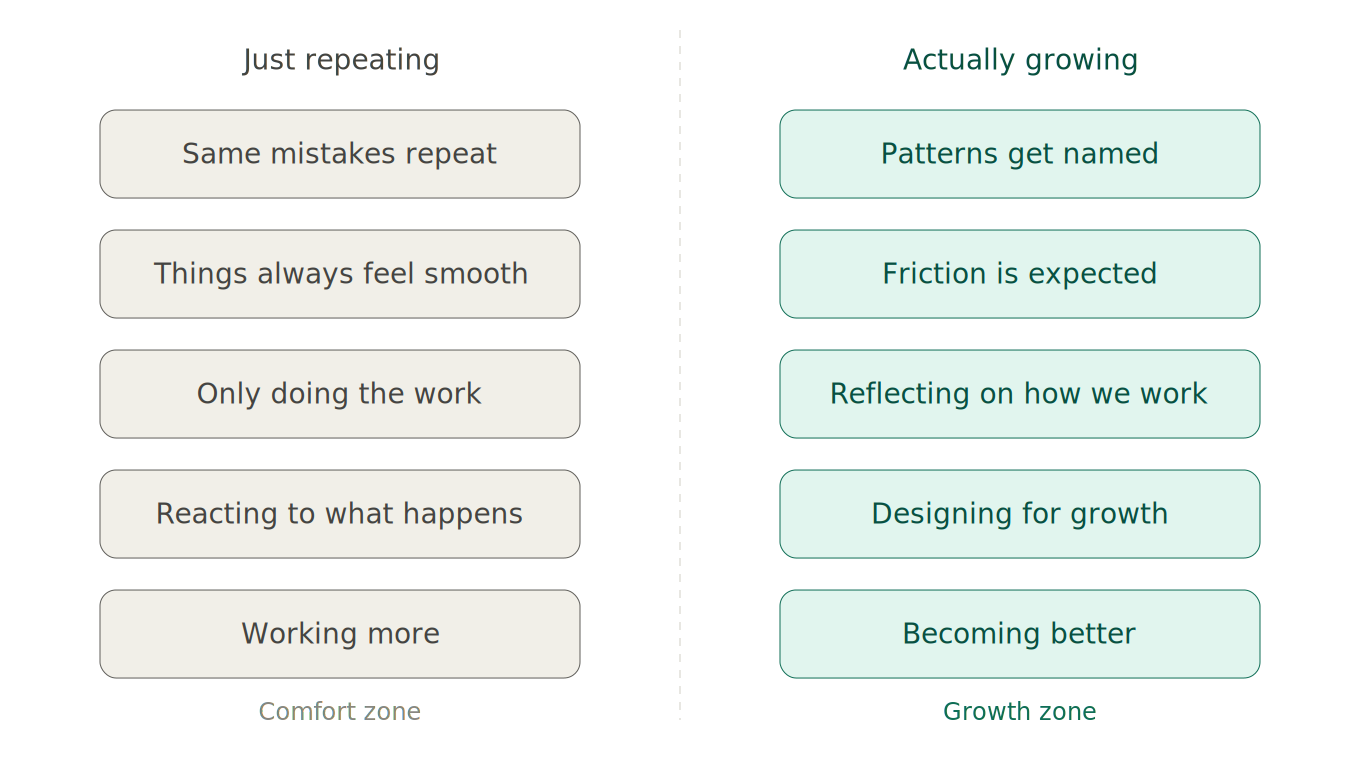
When you step back and look at what makes a team stronger, it’s not just output. It’s the ability to adapt, to stretch into new territory, to grow in capability and cohesion. That kind of growth doesn’t always show up in dashboards. It often shows up as friction or frustration. As a moment where the usual way of doing things doesn’t cut it anymore. I believe that if you are not hitting that kind of wall now and then, odds are your team isn’t evolving.
They’re just repeating.
Most learning is organic but there are moments when you need to look for it. In most teams, learning happens by doing. Here is what that cycle looks like:
A problem comes up > The team works through it > A new skill or habit gets formed.
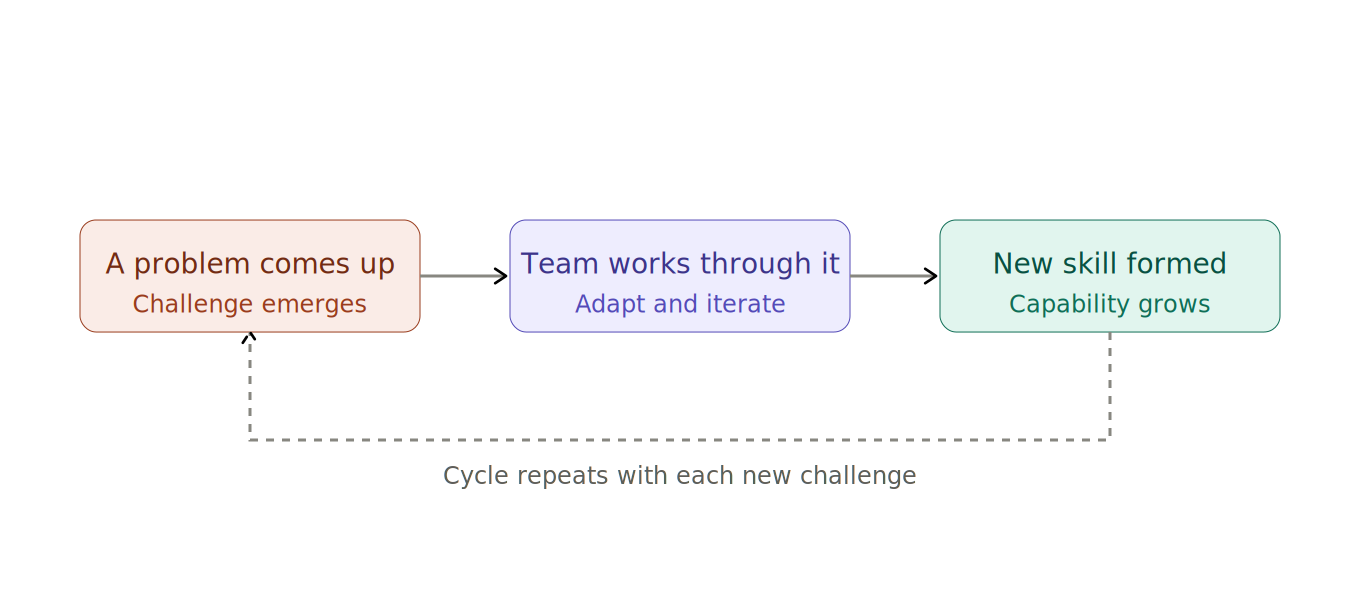
This is healthy and organic. But what happens when a team hits the same kind of problem, over and over, and doesn’t move forward? Usually, this is not because of a lack of will. Call me an optimist but I am convinced that most people want to do a good job. Rather, this is a signal: the team is faced with challenges that go beyond its current foundation. The base layer of skills, processes, and habits that carried them this far can’t take them further. This is when growth can’t happen organically. It needs something else: a deliberate learning intervention.
That brings me to the three types of team growth. The team distinction is important here. Individual growth is a mature field of study and we know a lot about the conditions for individual growth. At a team level, not so much.
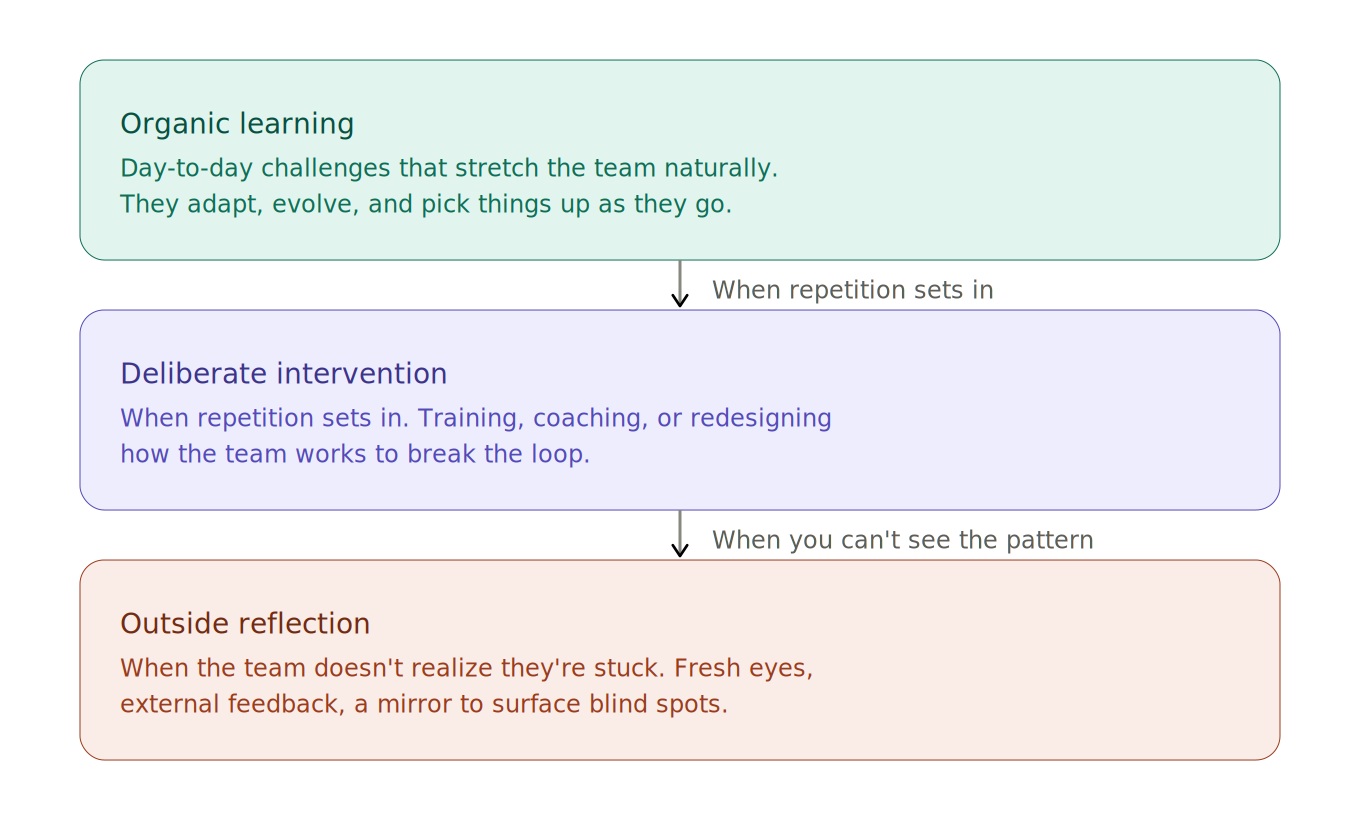
You can think of team learning in three layers:
Organic learning
Day-to-day challenges that stretch the team naturally. They adapt, evolve, and pick things up as they go.
Deliberate intervention
When repetition sets in, you see the same mistakes, the same frictions, and it’s time to break the loop. That might be training, facilitation, coaching, or redesigning how the team works.
Outside reflection
Sometimes the team doesn’t even realize they’re stuck. That’s when you need a mirror, like external feedback, a culture mentor, a retro with fresh eyes, something to surface the blind spots.
Most high-performing teams cycle through all three. The important distinction is that they don’t wait for growth to happen. They design for it. Research shows that top teams spend a lot of time talking about how they work—not just doing the work. Studies from Google’s Project Aristotle, McKinsey, and others confirm it: Healthy teams don’t just execute. They step back often to reflect, adjust, and sharpen how they collaborate. The common finding in all this nascent team research is that high-performing teams spend about 25% more time on reflection than other teams. This is important. If your team is only doing the work, and you are never facilitating a discussion about how the team works... you’re leaving progress on the table.
What does “better” actually mean?
This is where it gets tricky because performance and growth aren’t always easy to measure. You can count features shipped or lines of code, or track marketing KPIs or bug fix velocity. But those numbers don’t always tell the story. Same goes for life outside work. I recently asked a group of senior leaders about their last vacation. Some answered that it had been truly amazing, for others it was more of a ‘meh’. Both perspectives were very clear but nobody in that group had a scorecard or OKR list to look at to assess the quality of their vacation. Yet somehow they knew the exact difference between amazing and ‘meh’. Or think about how to assess if you’re a better partner than you were a year ago? You can count flowers bought or “I love you’s” said, but that might miss the point. If it doesn’t feel better for the other person, does it matter?
Performance without connection can feel like theater and the same is true for teams. You can hit every target and still be stagnating underneath. The best way to know if your team is growing is to talk about it; openly, honestly, and regularly. You can ask questions like:
What does this team aspire to be?
Where are we stuck—and why?
What do we do really well and can multiply further?
Are we learning fast enough for what’s ahead?
Are we doing things just because they worked before?
There is one thing that is needed to get an honest answer on all these questions; trust. Without that, people won’t speak honestly. They’ll withhold concerns, avoid hard truths, and protect themselves instead of improving together. I’ll write about the importance of trust and how to increase it in another post. If your team can’t name what’s not working, they can’t fix it. If your team doesn’t feel safe to challenge each other, they won’t grow. Creating the space to reflect together is one of the most high-leverage things you can do as a manager.
But where to start? I always say that one of the most important things a manager can do is to expose their authentic intent. This area is no different. Start by asking some of the questions above. Take the team through the why behind why you are asking these questions. Start small and show you are taking their answers to work in pragmatic efforts to improve. Show and reflect where things aren’t clear. Slowly but surely, the layers of the onion will peel off and you will get to the core of what deliberate growth effort your team needs, on of the organic cycle they go through all the time. Build space for that work, remember that high performing teams spend up to 25% more time having these discussions and setting up the foundation for their work, rather than just ‘working’. And they are more impactful as a result.
Find the friction
If your team is never hitting a wall, they’re probably just staying in their comfort zone. If things always feel smooth, you’re likely not pushing the edge of what’s possible.
Ask the hard questions. Build the safety to answer them. And lead your team not just to do better, but to become better.