
Leadership coaching, inside your organization
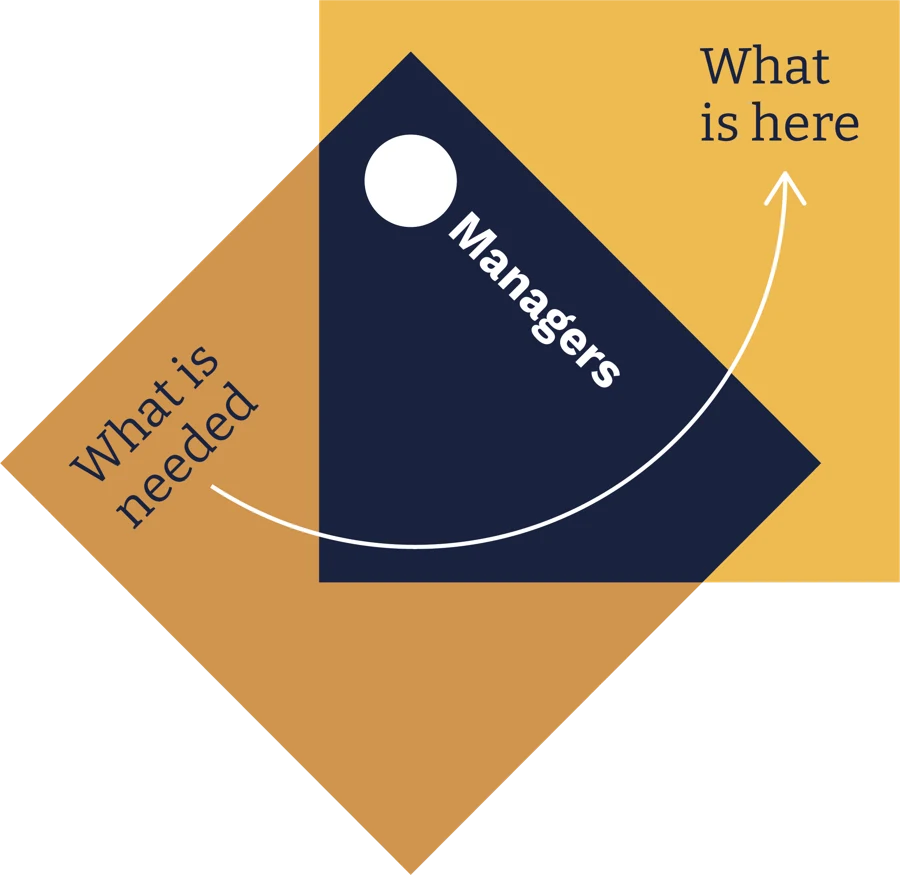
Strategy gets translated into execution through your managers. I help close the gap between the two.
What I solve
Most of what holds an organization back is not a lack of skill in any one manager. It is the dynamic between people: in how a leadership team works together, in how strategy lands once it reaches the people who have to make it come alive, and in tensions between individuals and teams.
In the age of AI, this matters more, not less. When execution speeds up, misalignment compounds faster.
Inside one organization, I coach multiple managers, facilitate their teams, and help the leadership team act on the patterns I see. I help close the gap between the designed and the lived organization.
Why managers in the middle matter
70%
Managers account for at least 70% of the variance in employee engagement across teams.
Gallup, State of the American Manager ↗28%
Only 28% of executives and middle managers responsible for executing strategy could list three of their company’s strategic priorities.
MIT Sloan Management Review, 2018 (124 organizations) ↗3 in 4
HR leaders say their managers are overwhelmed by the expansion of their responsibilities. 69% say leaders and managers are not equipped to lead change.
Gartner survey of HR leaders, 2024 ↗Inside & outside
Coaching with one foot inside, and one foot outside
The context from the inside makes it relevant, the outside perspective keeps you honest.
One foot inside
Inside far enough to understand exactly how your organization works today, and to coach your managers one at a time, in the context they share. I can then connect that back to your leadership team and your role in setting the organization up for success.
One foot outside
Outside far enough to see the patterns that are harder to spot from the inside, and to say them out loud, because I do not need the promotion and I am not defending any team or department.
Why it works
The unit of change is the relationship, not the individual.
Coaching one manager in isolation is a one-to-one effect. Coaching multiple managers in the same organization, while knowing what the leadership team wants to achieve and what teams are struggling with at the same time, produces something no single coach, survey or engagement score can produce:
a live picture of where strategy gets stuck between people.
The unit of change is never the individual manager, or even the team. It is the multitude of relationships between managers, their leaders, their peers and their teams, and the agreements they make with each other about how to work. That is what makes or breaks an organization.
What we will improve, together
Observable change, through lenses we design together
Improvement is not always a number, and I will not pretend it is. But improvement is always observable, by you. These are some examples of what that looks like.
What you will notice
Tough choices get made, with buy-in that lasts
In practice
Trade-offs are visible and agreed upon by those who need to carry the execution. Decisions are not backtracked and the underlying work gets delivered.
What you will notice
The gap between strategy and the conditions to execute it comes into view
In practice
Managers don’t report out to please the leader, they report out what stands between them and doing what is needed.
What you will notice
Culture and desired behavior become more than a poster on the wall
In practice
Managers and teams make the cultural aspirations their own, and translate them into the shifts their work needs right now.
What you will notice
An honest dialogue about how AI is reshaping the work
In practice
Managers and teams own the redesign of their work with AI. The conversation is about what the work needs, not about tool adoption numbers.
How I work
Across three levels of the organization at once, so patterns that no single team can see become visible.
01
With the leadership team
I hold up a mirror, honestly and without an agenda: how the leadership team works together, how that lands in the rest of the organization, and where the opportunity lies to change it.
02
With directors and managers
1:1 coaching that helps each director and manager become more effective in their own situation, with their own team, combined with group sessions that build a shared language and practical tools.
03
With teams
Facilitated sessions for teams that need clarity on their objectives and ways of working, or where collaboration across teams needs attention.
“The frameworks he introduced to me made my thinking so much clearer without feeling theoretical. He has an amazing way of asking the right questions to get me to think deep.”
Director, technology company
“I have used Erwin as my safe sounding board, pressure-testing my ideas, strategies, and challenges before I bring them to my leader.”
Director, technology company
Who this is for
Organizations where the middle holds the biggest potential
Organizations of roughly 500 to 3,000 people with complexity and growth challenges, where the manager layer has become the place strategy gets stuck, and at the same time holds the biggest potential to accelerate the organization forward.
Part of the formula is working with multiple managers across a longer timespan, so that I can help the leadership team fine-tune how the organization is set up for success, next to the immediate benefit of one-on-one coaching for the managers.
My preferred approach is to do this part-time, with a few clients at once, so that one foot always stays outside. That allows me to be the outside perspective on organizational health you need.
Start working with me
Start small. If it works, we go further.
I do my best work in longer, embedded engagements, inside the organization. How deep and how long depends on your organization. This kind of work can only be impactful when there is a fit, on both sides.
So I prefer to start with a workshop or another activity that stands on its own. If it works, we go further from there. If it does not, we both know early.
Background
- 22.5 years at Microsoft, leadership roles across sales, marketing, services and strategy
- Trained in Organization and Relationship Systems Coaching (ORSC)
- Author of Guide Your Team to Success
- Works in English, German and Dutch
My point of view
I write about the middle of organizations: what the manager's job means today in a rapidly changing world. It is where I work things out in public, and the best place to see how I think.
Get in touch
The first conversation is always exploratory.
I want to understand what your organization is dealing with before proposing anything.